Here is the short answer: inspectors from the New York City Department of Transportation walk the city's 12,000-plus miles of sidewalks looking for defects. If they spot one next to your property, a Notice of Sidewalk Violation shows up in your mailbox. It is not a fine, but it starts a 75-day countdown to fix the problem, and the saga only ends when a follow-up inspection confirms the work.
That is the process in a nutshell. The details matter, though, because a misunderstood inspection can cost you money or saddle you with repairs you did not need. Here is how inspections get triggered, what inspectors really check, what that sketch in the envelope means, and what to do if you think they got it wrong.
What actually triggers an inspection
Most owners assume an inspection only happens after somebody complains. That is one way, but far from the only way.
NYC DOT inspects sidewalks all over the city on its own initiative, simply to keep pedestrian space safe. On top of that, anyone can report a broken, collapsed, or caved-in sidewalk through 311, and those reports send inspectors out too. It might come from a routine patrol, or from the neighbor who tripped on your cracked slab last Tuesday. You will probably never know.
And to be clear about whose problem this is: under city law, the sidewalk next to your building is yours to maintain, not the city's. Here is who is responsible for sidewalk repairs in NYC.
One wrinkle: damage caused by tree roots is a different department's business. That is NYC Parks and its Trees and Sidewalks Program, which offers free consultations before you do work around roots. Do not cut or shave a city tree's roots yourself. That is strictly prohibited.
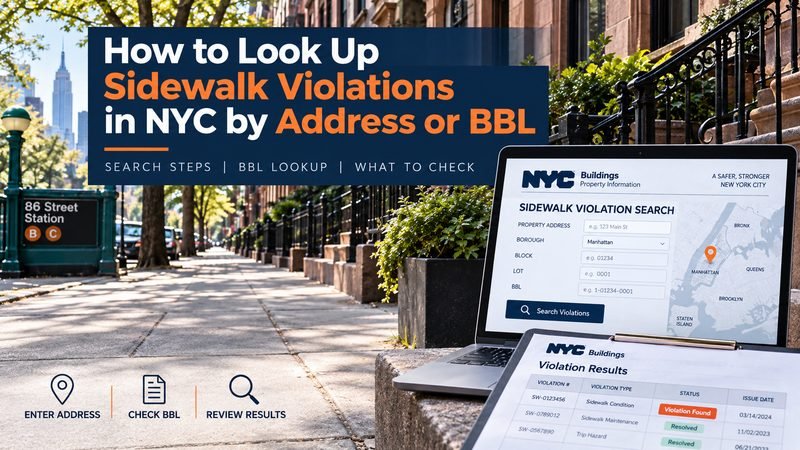
Oh, and do not expect a knock on the door. Inspectors work from the street and the sidewalk. They do not need your permission, and they will not stop to chat about what they find. The first you hear of it is usually the envelope in the mailbox. If you would rather not be surprised, you can look up your property to see whether a violation is already on its record.
What the inspector is actually looking for
You might picture an inspector giving your sidewalk a quick once-over and going with their gut. The reality is more specific: the defects they can cite are spelled out in Section 19-152 of the city's Administrative Code. Here is what tends to get flagged:
- Trip hazards. The classic. When one slab sits noticeably higher than its neighbor, thanks to frost heave or settling soil, that raised lip is what sends pedestrians sprawling. As a rough rule, a height difference around half an inch is where inspectors start paying attention.
- Collapsed or badly cracked sections. A slab that has caved in, shattered, or split wide open is an automatic problem. Hairline cracks are one thing; gaps you could catch a heel in are another.
- Improper slope. Sidewalks need a gentle, consistent pitch so water drains toward the street. A slab that tilts the wrong way, or one that ponds water every time it rains, can earn you a violation.
- Patchwork. That DIY asphalt smear from five years ago? Inspectors notice. Repairs done with unapproved materials or sloppy finishing do not meet the standard, and they can be cited as defects on their own.
- Hardware trip hazards. Cellar doors, utility caps, grates, and vault covers that stick up above the walking surface all count.
What is missing from the list: plain old ugliness. A stained but sound slab is fine. Inspectors grade safety, not curb appeal.
The sketch in the envelope is your roadmap
Your Notice of Sidewalk Violation never travels alone. It comes with a Preliminary Inspection Report (the PIR), including a sketch of your property with defective sidewalk flags marked by number. Think of it as the inspector's blueprint: every numbered flag must be replaced, and every defect corrected.
Check the property dimensions against reality, and look at where the sketch places trees, signs, utility caps, and cellar doors. If the drawing does not match your actual sidewalk, do not just shrug and pay for the work. A mismatch between the PIR and the real world is a legitimate reason to push back, and this guide to checking a sidewalk violation by address will help you make sense of what the city has on file.
One surprise: if you have collected more than one Notice of Sidewalk Violation, the newest one wins. It supersedes the earlier notices, so you only need to satisfy the latest report.
The 75-day clock (and how the city counts it)
From the moment the notice lands, you have 75 days to finish the repairs. The city counts from the certified mail receipt, or from the posting date if the notice was posted on your property instead. It is the same 75 days all year. Winter weather does not pause it, and pulling a repair permit does not extend it, so line up your contractor early.
Miss the deadline and the city can step in and do the work itself, or hire a contractor to do it, and then the Department of Finance sends you the bill. To ballpark that bill, multiply the square footage on your PIR by the cost per square foot printed on the letter that came with your notice. You get 90 days to pay before interest kicks in and a lien lands on the property. For a clearer picture, here is what NYC sidewalk violations typically cost.
The day the notice arrives, get organized: here is exactly what to do after receiving a sidewalk violation, step by step.
The final inspection most people forget to schedule
Here is what trips up even diligent owners: fixing the sidewalk does not clear the violation. Nothing here happens automatically.
Once repairs are done, contact 311 and request a Sidewalk Violation Dismissal Inspection. Have these ready when you call: your permit number, the property address, the block and lot number, the violation number, and your email and phone number. DOT sends an inspector to verify the work, so make sure the whole sidewalk is visible that day. Move the trash cans, the planters, and anything else camped on your new concrete.
Pass, and DOT notifies the County Clerk, which removes the violation from your property's record. Until then, it sits on file, where it can complicate a sale or refinance. If you are on the buying side of the table, always check a property for open violations before you buy.
Think the inspector got it wrong? Ask for a second look
Mistakes happen. Maybe the PIR sketch shows a tree that does not exist, or the "defect" sits on your neighbor's frontage. If the notice does not match the ground, you can request a re-inspection within 75 days of receiving it.
The fair part: the re-inspection is carried out by a different inspector who never sees the first report. A truly fresh set of eyes. You will get a letter at least five days before the date. And no, the inspector will not come to your door. They are prohibited from seeking out property owners during re-inspections. Whatever this second look finds is final, and the results arrive by mail.
Free tip: photograph your sidewalk the day the notice arrives, before anything changes. If you contest, dated photos are worth their weight in gold.
That is the whole journey: an inspector spots a defect, or somebody reports one. A notice and a sketch land in your mailbox. You get 75 days to fix it, and a dismissal inspection closes the book. Know the steps, keep your paperwork together, and it is far less frightening than that official-looking envelope makes it seem.