- The two laws that put the sidewalk on your shoulders
- What "your responsibility" actually covers
- The one big exception: small owner-occupied homes
- When the city fixes it anyway (and sends you the bill)
- Tree roots: the most common headache, and the one with a free fix
- The parts the city still handles
- Your move: what to do this week
If you own property in New York City, here is a surprise that catches almost everyone off guard: the sidewalk in front of your building is your job. Not the city's. Yours. Strangers walk across it all day, but when the concrete cracks, the repair bill lands in your mailbox.
This isn't landlord folklore. It's the law, in two Administrative Code sections worth knowing by number. Section 19-152 says you must install, repair, and maintain the sidewalk adjoining your property. Section 7-210 says you can be held liable if someone gets hurt because you didn't.
So the short answer is simple: you are responsible. The details are where it gets interesting. Which owners the law covers, where the exceptions are, when the city steps in anyway, and what it costs. Let's walk through it.
The two laws that put the sidewalk on your shoulders
For most of the city's history, a broken sidewalk was City Hall's problem. If you tripped, your claim was against the city, whose favorite defense was that nobody had given it prior written notice of that exact defect. No notice, no payout.
That ended in 2003, when Section 7-210 flipped the arrangement: the duty to keep the sidewalk reasonably safe moved from the city to the abutting property owner, and the liability moved with it. If someone is injured because you failed to maintain your stretch, the claim comes to you.
Section 19-152 is the other half. It's the maintenance law that lets DOT inspectors spot a defect and hand you a Notice of Sidewalk Violation. In short: 19-152 tells you to fix the sidewalk, and 7-210 tells you what it costs if you don't. Hiring a management company doesn't transfer the duty either; courts treat it as non-delegable, so it still has your name on it.
What "your responsibility" actually covers
The law asks for "reasonably safe," and DOT has spelled out what falls short: a collapsed section, a trip hazard where one flag sits a half inch or more above its neighbor, an improper slope, patchwork with unapproved materials like plain asphalt, and hardware such as cellar doors, grates, and utility covers that doesn't sit flush.
Snow, ice, dirt, and debris are named in the law too. Own a corner lot? Your territory includes the intersection quadrant wrapping around the corner.
Walk your frontage and look for lips between flags, toe-catching cracks, and rocking flags. That's a violation waiting to happen. Our guide to how DOT inspections actually work shows exactly what inspectors flag.
The one big exception: small owner-occupied homes
Here's the carve-out that surprises people in the other direction. If your property is a one-, two-, or three-family home, you live in it (even partly), and it's used exclusively as a residence, Section 7-210 doesn't apply to you. The city keeps the injury liability for your sidewalk.
It gets better. The city doesn't charge owners of one-, two-, and three-family homes for repairing damage caused by a city tree or its roots. DOT no longer issues violations to these properties for damage caused solely by city trees, and it has gone back through old notices to cancel qualifying liens.
Not a free pass, though. The exception covers liability and tree damage, not maintenance in general. Other defects can still earn you a violation, so fix problems before they harden into citable defects.
When the city fixes it anyway (and sends you the bill)
When DOT finds a defect, an inspector issues a Notice of Sidewalk Violation. There is no fine attached. The notice is filed with the County Clerk and stays on your property's record until the city confirms satisfactory repairs, which can complicate a sale or refinancing if you let it sit.
How the 75-day clock works
From the day you receive the notice, you have 75 days to repair. The clock starts with the certified mail receipt, or the posting date if it was taped to your property. Fine print: the newest notice supersedes older ones, every numbered flag on the inspection sketch must be replaced, and pulling a permit (currently $70 per 300 linear feet) does not pause the clock. Line up your contractor early.
What the city's bill looks like
Miss the deadline and DOT can do the work itself or hire a contractor, then the Department of Finance bills you under Section 19-152. DOT's estimating formula: multiply the square footage on your Preliminary Inspection Report by the per-square-foot rate in the letter that came with your notice. Driveway areas use thicker, pricier seven-inch concrete. Contractors will tell you bluntly that the city route usually costs more than hiring your own crew. See our breakdown of what sidewalk violations cost, and if a notice is already in your hands, read what to do the moment a violation notice arrives before those 75 days slip away.
Tree roots: the most common headache, and the one with a free fix
Tree roots cause more sidewalk violations than anything else, heaving flags upward a little more every year. Here's the catch: you may not just cut them. Cutting or shaving a city tree's roots is strictly prohibited. Only the Parks Department can touch them.
The free route: Trees and Sidewalks
This is what the Trees and Sidewalks Program is for. Run by NYC Parks, it repairs root-damaged sidewalks free, but only for one-, two-, and three-family homes. Request an inspection through 311 or the Street Tree Map. Sites are ranked on damage severity, pedestrian traffic, and tree health, with the worst fixed first. Fair warning: with around 9,000 requests a year, even severe cases can wait up to three years.
The faster route: fix it yourself, get reimbursed
Can't wait? Hire a licensed contractor yourself. You'll need a Tree Work Permit for work within 50 feet of a city tree, and Parks offers free consultations to keep you clear of the root rules. Keep receipts: you may get reimbursed through the City Comptroller if you file within 90 days of finishing.
The parts the city still handles
The city didn't hand over everything. It still maintains sidewalks in front of city-owned property, replacing more than two million square feet a year, mostly on city-owned land and in residential neighborhoods of one-, two-, and three-family homes.
Standard street curbs are generally the city's too, and DOT may fix a defective one at no cost during violation-related work. The curb cut is the exception: a driveway apron cut for your property is yours to maintain. Courts have likewise kept tree wells and pedestrian ramps under city jurisdiction.
If a utility or contractor tore up your sidewalk, photograph the damage, look up the DOT permits for your block, and file with the company's claims department. The violation clock won't pause while you argue about it. And the city flat-out won't touch vaults: if the defective stretch sits over a basement vault beneath the pavement, the structural repair is entirely yours to arrange privately.
Your move: what to do this week
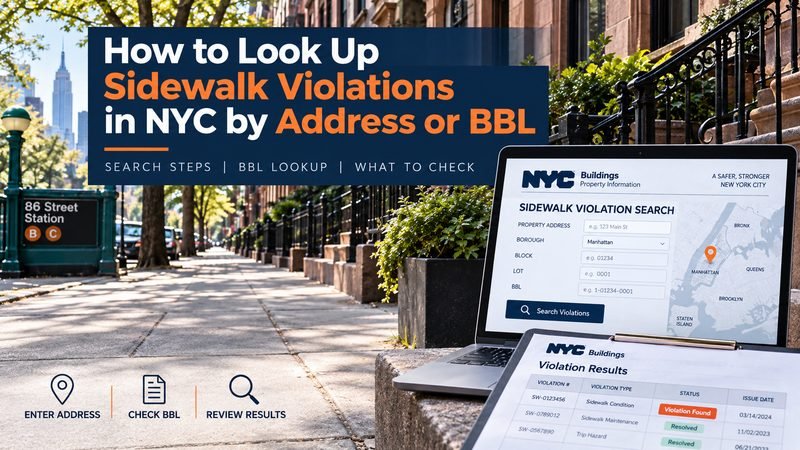
First, find out where you stand: run your address through the free lookup tool on our homepage, or follow our step-by-step guide to checking a violation by address.
No violation on record? Walk your frontage anyway and fix small problems before they become citable defects. Shopping for property? Make checking for open violations part of your due diligence, right next to the title search.
When work is needed, hire a contractor who knows DOT specs (verify through the city's licensed-contractor database), pull the $70 permit, and call 311 to schedule your dismissal inspection when the work is done. The violation doesn't clear itself.
Know the two code sections, keep your flags even, and route tree-root problems through the proper channels. Your ankles, and your wallet, will thank you.