- Step 1: Find Your Property's BBL
- Step 2: Search the Sidewalk Management Database, Violations Dataset
- Step 3: Know What to Look For in the Results
- Step 4: Also Check the Sidewalk Dismissal Inspection Tracking Dataset
- Step 5: What It Means If Nothing Appears
- Step 6: How 311 and DOT Case Status Fit In
- Step 7: If You Find an Active Violation
- The 75-Day Repair Period and How It Starts
- Why a Sidewalk Violation Isn't a Standalone Fine
- Before You Rely on a "No Results" Search: A Note for Buyers, Sellers, and Attorneys
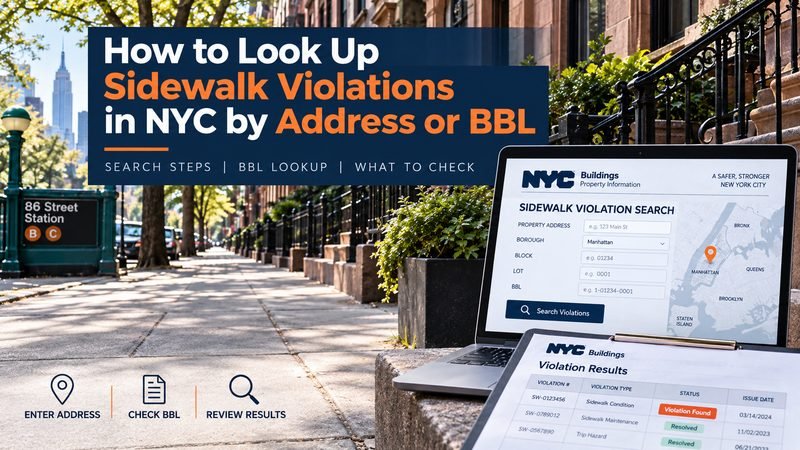
Every property in New York City is tied to a Borough-Block-Lot (BBL) number, and if a sidewalk defect gets serious enough, DOT records a Notice of Violation against that BBL. The good news: this record is public. The less good news: most guides on the internet describe a simple "type your address into DOT's search tool" box that, as of this writing, doesn't actually appear on nyc.gov. The real process runs through NYC Open Data and 311. Here's how it actually works.
Step 1: Find Your Property's BBL
If you only have a street address, get the BBL first. It's the identifier that connects records across city agencies more reliably than an address alone (addresses occasionally get mismatched between systems; a BBL doesn't).
You have a few legitimate options:
-
NYC Department of Finance Property Information Portal: search by address to pull up your BBL along with basic property details.
-
ACRIS (Automated City Register Information System): also returns BBL and is useful if you need deed or lien history for Manhattan, Brooklyn, Queens, or the Bronx.
-
ZoLa (NYC Planning's zoning and land use map): also searchable by address, also shows BBL.
Any of these will work. Write down your BBL in the format Borough, Block, Lot (for example, 3-01234-0056) before moving to the next step.
Step 2: Search the Sidewalk Management Database, Violations Dataset
The actual system of record is a NYC Open Data dataset called Sidewalk Management Database, Violations, maintained by DOT. It currently holds well over 300,000 records and is updated regularly.
To search it:
-
Open the dataset link above.
-
Use the built in filter/search function rather than a plain keyword search. You can filter by BBL, or by house number and street name.
-
If you're checking a property, filter by BBL for the most precise match. Street addresses in the dataset are split into separate fields (house number and street name), so an exact address string search may not return results the way a Google search would.
This is the same underlying data DOT inspectors use, so it's as close to the source as you'll get without calling the agency directly.
There are also independent tools built on top of this same city data that let you search by address directly, rather than filtering the raw dataset yourself. NYC Sidewalk Violation Lookup fetches directly from the city's Sidewalk Management Database and updates daily, so you can check your address there and see whether a violation is open or already dismissed before you pick up the phone. Confirm anything that affects deadlines or money (dates, dollar amounts, dismissal status) through NYC 311 or DOT directly, since even a daily refresh can lag a same-day filing by a few hours.
Step 3: Know What to Look For in the Results
If your BBL returns a row, here's what actually matters:
-
Violation issue date: confirms a Notice of Violation exists and when it was issued.
-
Dismiss date: if this field is blank, the violation is still considered active. A filled in date means DOT has closed the case.
-
Certified mail / notice date: this is what starts your repair clock (more on that below).
-
Defect indicators: separate fields flag the specific problem, including trip hazard, improper slope, missing sidewalk, undermined sections, patchwork, and hardware.
-
Square footage of defective sidewalk: tells you the scope DOT identified.
-
Violation number: useful to have on hand if you call DOT or 311.
If several of these fields are unfamiliar, DOT's Sidewalk Repair Checklist also explains defect types in plain language.
Step 4: Also Check the Sidewalk Dismissal Inspection Tracking Dataset
This is the step most guides skip, and it matters. DOT keeps active violations in the dataset above, but once a violation is resolved and dismissed, that record moves to a separate dataset: Sidewalk Dismissal Inspection Tracking.
That means if you search only the Violations dataset and find nothing, it could mean one of two very different things:
-
No violation was ever issued for that property, or
-
A violation existed and was already resolved and dismissed.
For a clean read on a property's full history, check both datasets by BBL, not just one.
Step 5: What It Means If Nothing Appears
A blank result in both datasets generally means there's no violation currently on file. But two caveats are worth knowing:
-
New inspections and 311 complaints get added on a rolling basis, so a property that's clean today could be flagged next month.
-
Sidewalk defects caused solely by city-owned street trees are handled somewhat differently for 1, 2, or 3-family-owner-occupied homes. The city may not issue a violation or lien in that specific scenario, which can affect what does or doesn't show up.
Step 6: How 311 and DOT Case Status Fit In
If you already have a specific case or service request number (say, from a violation notice you received, or a 311 complaint you filed), DOT's Check Case Status tool lets you enter an address or drop a pin on a map to locate that case. It's built around existing service requests and cases, not as a general search by address violation lookup, so it's a good second step once you have a reference number rather than your starting point.
For anything not showing up clearly in Open Data, NYC311 (dial 311 or use the NYC311 portal) can also confirm status directly and is the right channel to schedule things like a dismissal inspection once repairs are done.
Step 7: If You Find an Active Violation
-
Note the violation issue date and which defects were flagged.
-
Confirm the 75-day repair window (see below) and mark your deadline.
-
Every numbered flag on the Preliminary Inspection Report sketch that came with your notice needs to be replaced or corrected, not just the most visibly damaged one.
-
Hire a DOT-familiar, licensed contractor to pull the necessary sidewalk permit and complete the repair to spec.
-
Once work is done, call 311 to schedule a dismissal inspection, providing your permit number, property address, BBL, and violation number.
The 75-Day Repair Period and How It Starts
Under NYC Administrative Code §19-152, a property owner has 75 days to make repairs after receiving a Notice of Sidewalk Violation. That clock starts on the date shown on the certified mail receipt. If the notice isn't delivered by mail, DOT posts it on the property instead, and the posting date starts the 75 days. If you receive multiple notices for the same property, the newest one supersedes earlier ones. This period is consistent year round.
Why a Sidewalk Violation Isn't a Standalone Fine
This is worth being precise about, because it's a point where a lot of information online gets muddled. A Notice of Sidewalk Violation is not, by itself, a monetary fine. It's a directive to fix the sidewalk within the deadline.
The financial risk only kicks in if you miss the window. At that point, DOT can have the repair done by its own contractor, and the Department of Finance bills the property owner for the cost of that work, plus an administrative charge that, under §19-152(e), is capped at up to 20% of the repair cost (not a flat add-on). If that bill goes unpaid, it can become a lien on the property, and unresolved liens can eventually be included in the city's annual tax lien sale, where a private buyer takes over collection with its own interest charges.
Before You Rely on a "No Results" Search: A Note for Buyers, Sellers, and Attorneys
If you're checking a property ahead of a sale, refinance, or closing, a clean Open Data search is a good sign but not a full clearance:
-
Confirm you searched both the Violations and Dismissal Tracking datasets by BBL.
-
A recorded lien from a past city performed repair can outlive the violation record itself. A full title search through ACRIS or a title company will catch liens that a sidewalk specific dataset search might not flag clearly.
-
If a property has multiple structures or recent lot mergers/splits, double-check that the BBL you're searching for still matches the current property configuration.