If you are buying property in New York City, do this before you fall in love with the kitchen: check the property's violation and lien history. The Departments of Buildings, Transportation, Housing Preservation and Development, and Finance all keep public records on every address, and any of them can turn up something the listing photos will never show you.
Why does it matter? In New York City, violations stick to the property, not the person who caused them. Buy a building with open violations and unpaid fines, and congratulations, they are yours now. An afternoon of digging before you make an offer can save you from inheriting someone else's mess.
The good news: nearly all of it is public and free. Here is where to look, and what to do with what you find.
Start with the sidewalk (yes, really)
Most buyers obsess over the apartment and forget the concrete out front. When DOT inspectors find a defective sidewalk, they issue a Notice of Sidewalk Violation. No fine is attached, which is why owners ignore it. But a copy gets filed with the County Clerk and stays on record until the city confirms repairs, and in the DOT's own words, a violation "may complicate selling or refinancing a property."
The owner gets 75 days from receipt to repair. Miss the window and DOT can send its own contractor, then have the Department of Finance bill the owner under Section 19-152 of the Administrative Code. City-done work almost always costs more than hiring your own licensed contractor.
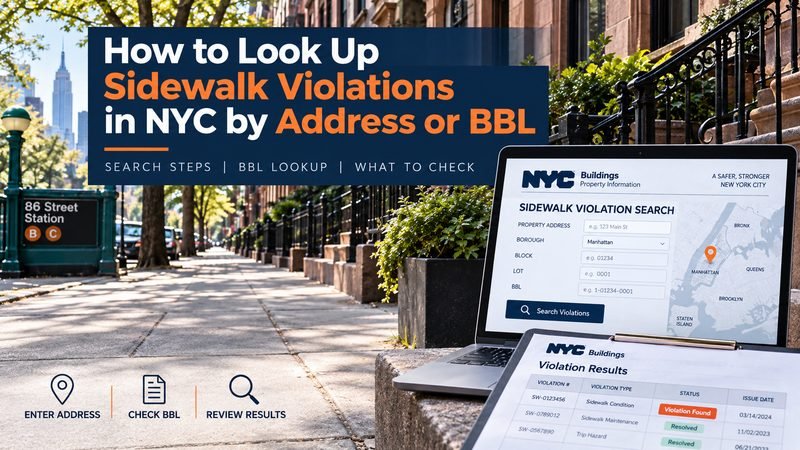
Before you go further, run the address through a free sidewalk violation lookup. If something pops up, our step-by-step guide to checking a sidewalk violation by address shows you how to read it. Also worth a look: who is actually on the hook for sidewalk repairs and how NYC sidewalk inspections work.
Pull the building's record at the Department of Buildings
The DOB's Buildings Information System (BIS), now part of DOB NOW, is the public file on every building in the city: permits, complaints, and violations, searchable by address. Think of it as the building's permanent record.
Two kinds of trouble show up here: DOB violations, and OATH summonses (the old ECB violations) that come with a hearing. They arrive in three flavors: Class 1 (Immediately Hazardous), Class 2 (Major), and Class 3 (Lesser). A Class 1 should make your eyebrows go up.
In BIS, an open DOB violation shows no asterisk; a dismissed one gets one (like V*7052-18P). Here is the quirk: a violation stays "open" until the owner submits proof the condition was corrected, even if the fine was paid years ago. An open violation from 2019 might be a real hazard or just missing paperwork. Ask the seller which it is.
The city is blunt: "Open violations can prevent an owner from selling or refinancing." The DOB will not issue a new or amended Certificate of Occupancy while violations are active.
Check housing violations too
Buying residential? HPD Online is your next stop. Free, searchable by address, block and lot, or building number. This is where heat and hot water complaints, vermin issues, and lead paint violations live.
Ask the same detective questions. Are problems building-wide, like the boiler, facade, or elevators, or confined to one apartment? Building-wide is the red flag. A building with heat complaints every winter does not have a paperwork problem. It has a landlord problem, and you would be buying it.
Follow the money: liens and judgments
Violations are half the story. The other half is money owed against the property, and for that you want ACRIS, the Automated City Register Information System run by the Department of Finance at a836-acris.nyc.gov: deeds, mortgages, and liens recorded with the City Register (back to 1966 in Manhattan, 2003 elsewhere). Free, no account, searchable by address, block and lot, or owner name.
Property tax and water liens
Each year the Department of Finance publishes a tax lien sale list for properties owing more than $1,000 in taxes, water and sewer charges, or emergency repair charges ($5,000 for one-to-three family homes). Owners get roughly 90 days' notice to pay or set up a plan. Once sold, the lien accrues 18 percent annual interest. Search the DOF property tax portal by block and lot to see where the property stands. The Department of Environmental Protection bills water and sewer quarterly, so check balances at nyc.gov/dep too. Water liens are especially common in multi-family buildings, where one bad meter can run up a shocking bill.
Unpaid violation judgments
Unpaid ECB and OATH penalties do not sit quietly. Roughly 75 days after a hearing decision, they can be docketed as civil judgments that attach to the property and show up in title searches. Check nyc.gov/oath for outstanding penalties. A stack of old judgments can kill a closing, since no title company will insure over them.
Mechanic liens
If the seller recently renovated, pay attention. Contractors and suppliers can file a mechanic lien for unpaid work within 8 months of their last day on the job (4 months for single-family homes). A beautiful new kitchen could still have a lien in its future. Ask for lien waivers and check ACRIS for filings from the past couple of years.
The rule that changes everything
Here is the part that surprises almost every first-time buyer: in New York City, violations and liens attach to the property, not the seller. The day you close, you step into the prior owner's shoes, problems and all. Title companies know this cold, which is why open violations and judgment liens can delay or derail a closing. No clean title means no title insurance, and no title insurance means no mortgage.
But this rule is also your bargaining power. A standard NYC contract lets your attorney require the seller to clear violations before closing, or hold funds in escrow until they are dismissed. Do this during due diligence, while you can still negotiate, not the week before closing.
Your pre-offer checklist
Run through these before you make an offer, not after. Future you will be grateful.
- Look up the address for DOT sidewalk violations and note any open notices.
- Search the DOB BIS/DOB NOW property profile for open violations and OATH summonses.
- Check HPD Online for housing violations, complaints, and inspection history.
- Search ACRIS for deeds, mortgages, mechanic liens, and recorded judgments.
- Check the DOF tax portal and the annual tax lien sale list for the block and lot.
- Look up outstanding ECB and OATH penalties on the OATH portal.
- Walk the property yourself: the sidewalk, the facade, the hallways, the boiler room if you can get in. Your eyes catch things that were never filed anywhere.
So you found something. Now what?
First, do not panic. A single old violation with no fine is often a paperwork ghost: fixed years ago, never certified. Ask the seller for the certificate of correction or dismissal letter.
For genuinely open items, require the seller to clear them before closing, negotiate a credit, or set up an escrow holdback that releases once the violation is dismissed. Structural, facade, or boiler violations? Bring in your own engineer first. An inspection is cheap compared to a facade restoration.
And if the sidewalk is the issue, here is what to do after receiving a sidewalk violation and what sidewalk violations can actually cost. Either way, loop in your real estate attorney early. This is exactly what they are for.
Checking a property before buying in NYC is not glamorous, but neither is paying off somebody else's violations. Spend an afternoon in the city's free databases and walk the sidewalk with your eyes open. Future you, the one holding keys instead of a repair bill, says thanks.