Here is the short answer to the question keeping you up at night: a New York City sidewalk violation does not come with a fine. The notice itself costs you exactly zero dollars.
Before you celebrate, though, know what that notice really is: the start of a 75-day clock. Fix the sidewalk yourself and you are looking at a contractor bill plus a $70 permit. Ignore the clock and the city will fix it for you, then mail you a bill that typically runs two to three times what a private contractor would have charged, with interest and a lien if you do not pay.
So let us walk through every dollar this process can actually cost, from the permit fee to the final bill, and the smartest ways to keep the total down.
The violation itself is free (yes, really)
The Department of Transportation says it plainly: there is no fine associated with a sidewalk violation. It is an official notice, not a summons, and nobody is asking you for money when it arrives.
A copy does get filed with the County Clerk, where it sits until the city confirms your repairs are done. That filing is free too, but it is not harmless: an open violation can complicate a sale or refinance, since buyers and lenders get nervous about unresolved city paperwork. Buying instead of repairing? Here is how to check a property for violations before buying in NYC.
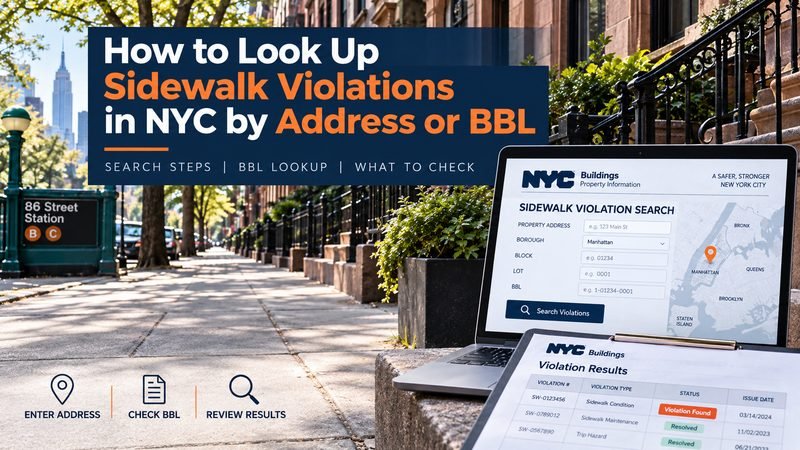
But here is the thing. The notice is free the way a warning light on your dashboard is free. The underlying problem still needs fixing, and the meter starts running the day the notice arrives. Not sure the notice on your door is even legitimate? Here is how to check a sidewalk violation by address before you spend a dime.
What a private repair actually costs
Most owners hire a private contractor, and this is where you control the final number. For standard concrete replacement, expect roughly $12 to $30 per square foot, with Manhattan at the higher end and the outer boroughs costing less.
What does that look like in real numbers?
- One damaged flag: about $600 to $800 all in
- A typical violation job (a few flags): $1,200 to $4,000
- Extensive replacement: $3,500 to $8,000 or more
- Curb work: $45 to $95 per linear foot
A solid quote should spell out everything: demolition, base prep, the pour to DOT specifications, permit filing, and inspection scheduling. Be wary of a bid that comes in dramatically lower than the rest. A suspiciously cheap quote usually means something got left out, and the usual suspects are the permit fee and the inspection. Ask directly.
Before you sign anything, check what actually caused the damage. If a city tree's roots lifted your sidewalk and you own a one, two, or three-family home, NYC Parks may repair it at no charge through its Trees and Sidewalks Program. Make that call first. Here is the full breakdown of who is responsible for sidewalk repairs in NYC.
The $70 permit is the best deal in this whole process
You cannot legally touch a New York City sidewalk without a DOT permit, and here is the rare piece of good news: it costs $70 and covers up to 300 linear feet, which handles nearly every residential property. Own a corner lot with work needed on both sides? You will need two permits, so budget $140.
That $70 covers the administrative cost plus the dismissal inspection, the visit where a city inspector verifies your repairs and officially closes the violation. A skipped or failed inspection keeps the violation open, so that is money well spent.
Homeowners doing their own repairs can apply by mail with a certified check to NYC DOT; contractors file online. Either way, a permit does not pause your 75 days. The clock keeps ticking. Here is how NYC sidewalk inspections, including the dismissal visit, actually work.
Do nothing, and the city sends you the bill
Miss the 75-day deadline and the DOT can step in, usually through one of its own contractors. You get a formal heads-up first: a city representative photographs the sidewalk, marks the flags to replace, and the crew does the job.
How is the bill calculated? The city takes the estimated square footage from your Preliminary Inspection Report, the sketch that came with your violation, and multiplies it by the per-square-foot rate printed on the letter that arrived with it. Driveway sections are priced at the 7-inch concrete rate and everything else at the 4-inch rate. Heads up: the final bill can come in higher if the crew had to fix extra defects to bring the sidewalk up to standard, and the per-square-foot rate varies from contract to contract.
Contractors who handle violations every day say city bills typically land at two to three times what a private job would have cost. The city is not trying to give you a deal. It is trying to get the sidewalk fixed.
Once the bill arrives from the Department of Finance, you have 90 days to pay before interest starts accruing. Miss that window and a monetary lien goes against your property. If the full amount stings, ask about a payment plan at a DOF Business Center or through 311. Think the bill is wrong or the work is shoddy? You can appeal: first to the Department of Design and Construction in writing (phone calls do not count), then to the Comptroller, then to small claims court. The city's contractor work also carries an 18-month guarantee.
Two exceptions worth knowing. The city will not repair sidewalk over a vault, so that one is on you no matter what. And the old expedited repair program is currently on pause, so do not count on it as a shortcut.
The costs nobody puts on the invoice
Some of the priciest consequences of a violation never show up as a line item. An open violation can stall a sale or a refinance, since many buyers and lenders want a clean property record before they sign anything. It can also turn into a legal headache. Under the Administrative Code, owners are potentially liable if someone gets hurt on a defective sidewalk, and a filed violation is a paper trail showing you knew about the problem.
One more thing to watch: a proposed City Council bill, Intro 1320, would add $250 civil penalties for missing the repair deadline, plus another $250 if the owner knew the condition was dangerous. Not law yet, but the message is clear: the consequence-free notice may be on its way out.
How to keep your total as low as possible
The cheapest violation is a fast one. Get quotes in week one, not week ten, since permit approval alone can eat a week or two of your 75 days. Get three written estimates and confirm each includes the permit fee and dismissal inspection, not just the concrete.
Verify every contractor's license through the Department of Consumer and Worker Protection's database before anyone breaks ground. Unpermitted work cannot clear a violation, no matter how nice the concrete looks. If tree roots are the culprit, call Parks before you call a contractor. Once the work is done, request your dismissal inspection through 311 with your permit number, block and lot, and violation number handy. Here is a step-by-step on what to do after receiving a sidewalk violation, and you can look up your property's violation status anytime with our free tool.
A sidewalk violation is the city handing you a 75-day head start, not a bill. Use the time, pick your own contractor, and the whole thing stays manageable. Let the clock run out, and the city handles it on its terms, at its prices. Your move.